
Скрытая стоимость “работаю с проблемами” on production lines
On the old production lines of many manufacturing enterprises, изначально было выбрано демонстрационное оборудование коммерческого уровня. Чтобы сократить затраты на закупки, коммерческие дисплеи действительно могут быть “ввести в эксплуатацию первым,” но среда на производственной линии гораздо жестче, чем в офисе: пыль и масляный туман., high temperature and humidity, constant vibration, 24×/7 operation, plus power grid fluctuations and electromagnetic interference. Commercial displays quickly reveal shortcomings: rapid brightness decay, flickering images, poor heat dissipation causing crashes, premature backlight aging, and often replacement every year or two. Frequent shutdowns to replace screens not only bring about cost of parts procurement, but also implicit losses in production efficiency and product quality.
With the acceleration of production line automation and informatization transformation, display devices, as the “window” for human-machine interaction, face increasingly prominent reliability issues. Replacing commercial displays withпромышленные дисплеи has become a must-have for upgrading old production lines.
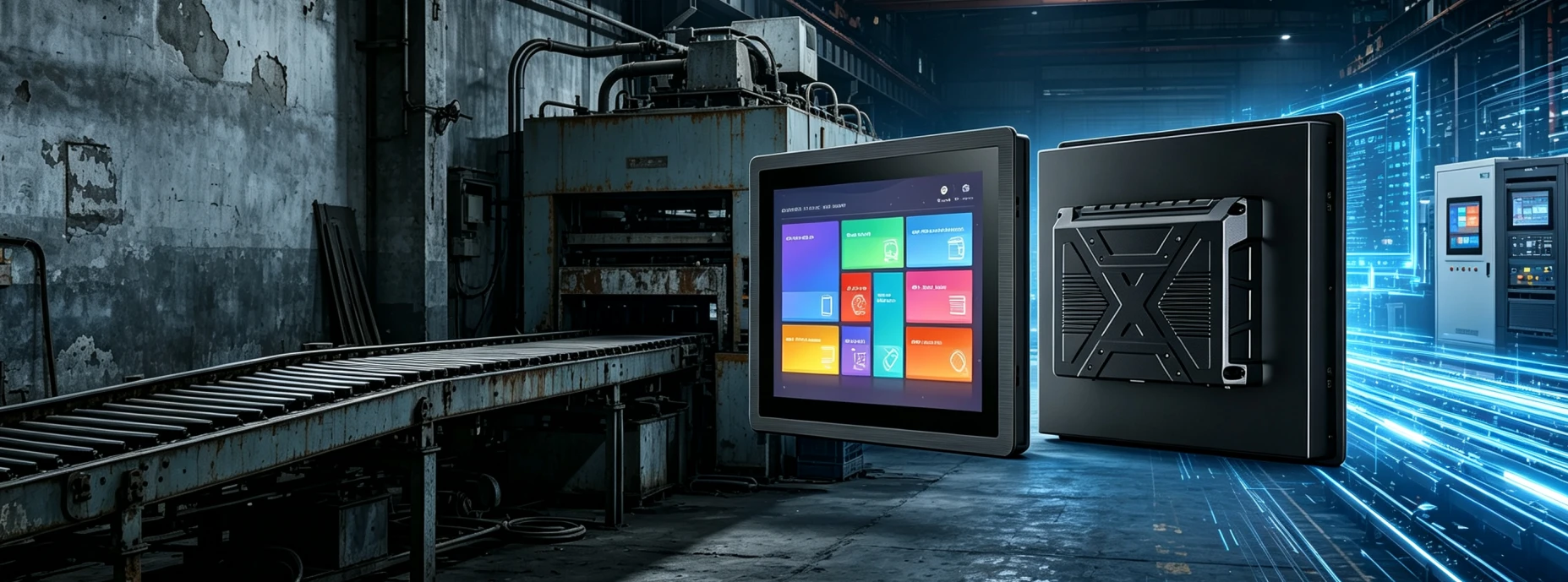
Key points for selecting industrial monitors
Production line renovation is not simply “replacing industrial screens with commercial screens” but a systematic project that requires clear selection requirements based on on-site conditions.
In terms of environmental adaptability, industrial monitors should support a wide temperature range (such as -10°C~60°C or even wider). The front panel should have IP65 dust and water resistance, allowing for long-term stable operation in dust and oil mist environments.
In terms of stability and reliability, industrial monitors should use industrial-grade components and wide-voltage power supplies, support long-term continuous operation, and possess a long mean time between failures as well as good resistance to vibration and electromagnetic interference.
In terms of display performance, industrial monitors have high brightness (≥500cd/m2 or even higher) to handle strong light environments, with wide viewing angles and anti-glare processing to ensure clear readability from multiple angles.
In terms of interface compatibility, industrial monitors retain common signal interfaces such as VGA, DVI, HDMI, facilitating seamless integration with existing industrial computers and PLC control systems, reducing the workload of retrofits.
For installation adaptation, industrial monitors should support multiple installation methods such as embedded, настенный, and desktop, aiming to match the original openings and brackets as much as possible to reduce modification and downtime.
Calculate the renovation costs
Replacing commercial screens with industrial screens may seem costly in the short term, but in the long run, it’s a “money-saving” вариант: longer lifecycles, fewer downtime failures, lower maintenance and spare parts costs, a clear advantage in overall ownership costs, and improved production line image and data display stability.
The following points should be noted during renovation:
1. Verify the on-site signal type and interface in advance, and configure a signal converter if necessary to avoid compatibility issues with “new screen with old cable.”
2. Pay attention to installation dimensions and heat dissipation space to prevent poor heat dissipation after renovation.
3. Choose suppliers who can provide long-term supply and after-sales service to avoid the risk of production and supply interruptions later.
4. Implement in phases according to the importance of the production line, first renovating key workstations and then gradually promoting them, reducing the trial-and-error cost of one-time upgrades.
От “Visible” к “Understandable.”
With the advancement of intelligent manufacturing, production line display devices are moving from passive displays to active intelligence: higher resolution, thinner bodies, the widespread adoption of capacitive touch and multi-touch have made human-machine interaction more direct.
By combining IoT and edge computing, industrial displays can serve as carriers for production data dashboards and equipment status monitoring, supporting wireless screen casting and remote operation and maintenance; Demand for special scenarios such as sunlight visibility and extreme temperature conditions is also continuously increasing. Industrial displays are evolving from a single display terminal into an important entry point for digital upgrades on production lines.
Summary and Outlook
In the renovation of old production lines, although the display process is small, it directly affects equipment operation and human-machine efficiency. Replacing commercial displays with industrial displays is essentially a reliability investment: in return, it brings more stable production, lower overall costs, and smarter production line foundations.
During renovation, scientifically select models based on on-site conditions, advance in phases, and choose professional industrial display solution providers with R&D capabilities and long-term service capabilities (such as Touch Intelligent) as long-term partners. В будущем, as production lines continue to deepen digitalization and intelligence, industrial displays will play a greater role, injecting new vitality into old production lines.