
Man mano che la trasformazione digitale della produzione diventa più profonda, MES (Sistema di esecuzione della produzione) è diventato uno strumento fondamentale per la maggior parte delle fabbriche per raggiungere una produzione snella. I terminali MES integrati in officina distribuiti nelle singole postazioni di lavoro fungono da collegamento critico che collega gli operatori in prima linea, linee di produzione e sistemi di gestione back-end.
Many factories make compromises by deploying consumer‑grade all‑in‑one PCs on production floors. Such devices tend to fail within 1‑2 years under harsh workshop conditions. Some users also pick poorly‑matched hardware with incompatible interfaces, which cannot connect to field equipment and end up dragging down overall production efficiency. This guide breaks down practical selection criteria for industrial MES terminals and introduces the TouchThink 3‑in‑1 shop‑floor terminal, a mature, well‑adapted solution for 2026 smart manufacturing scenarios.
Core Selection Criteria for Industrial MES Shop‑Floor Terminals
Industrial workshop conditions differ drastically from office environments. Hardware selection should focus on solving real‑world pain points rather than chasing raw spec numbers.
Environmental Adaptability Comes First
Factory floors commonly face heavy dust, contaminazione dell'olio, wide temperature swings and unstable power supply. Qualified MES terminals must meet these hard requirements:
- Fan‑less architecture: No moving mechanical parts to avoid heat dissipation failures caused by dust buildup inside fans. It also lowers noise and reduces routine maintenance workload.
- Rugged full‑metal chassis: Aluminum alloy housing delivers superior anti‑interference performance and wide temperature tolerance compared with plastic casings, supporting long‑term continuous operation in industrial settings.
- Opzioni di montaggio flessibili: Support embedded flush‑mount installation to save workstation space and keep production‑line layout neat. Wall‑mount, swing‑arm and pendant mounting should also be supported for diverse site conditions.
Customizable I/O Interfaces for Peripheral Integration
MES shop‑floor terminals need to connect barcode scanners, PLC controllers, label printers, weighing sensors and other industrial peripherals. Native RS232 / RS485 serial interfaces are essential. Custom‑configurable terminals eliminate unstable external docking docks. Gigabit Ethernet is mandatory to guarantee loss‑less real‑time production data transmission.
Performance Tuned to Actual Workstation Needs, Not Blind Spec Hunting
Performance requirements vary widely across workstations. Low‑power configurations are sufficient for basic scanning and data entry. Core workstations running visual work‑order dashboards or AI inspection image processing demand stronger CPUs and larger memory. Vendors should offer multiple hardware variants so factories can balance performance and deployment cost.
Touch Performance Optimized for Factory Operators
Workers frequently operate terminals while wearing work gloves. The touch panel should support glove‑operated capacitive multi‑touch with high accuracy and responsive feedback to prevent workflow delays from laggy touch input.
2026 Recommended Solution: TouchThink 3‑in‑1 Shop‑Floor Terminal
With years of experience developing industrial HMI hardware, TouchThink’s 3‑in‑1 shop‑floor terminal is purpose‑built for MES‑driven smart factories. Its mechanical design, built‑in triple‑function modules and multi‑configurable hardware directly address typical pain‑points on production floors, delivering strong value among comparable industrial panel PCs.
Stand‑out Design Highlights
Ready‑to‑use, built for 24/7 shop‑floor deployment:
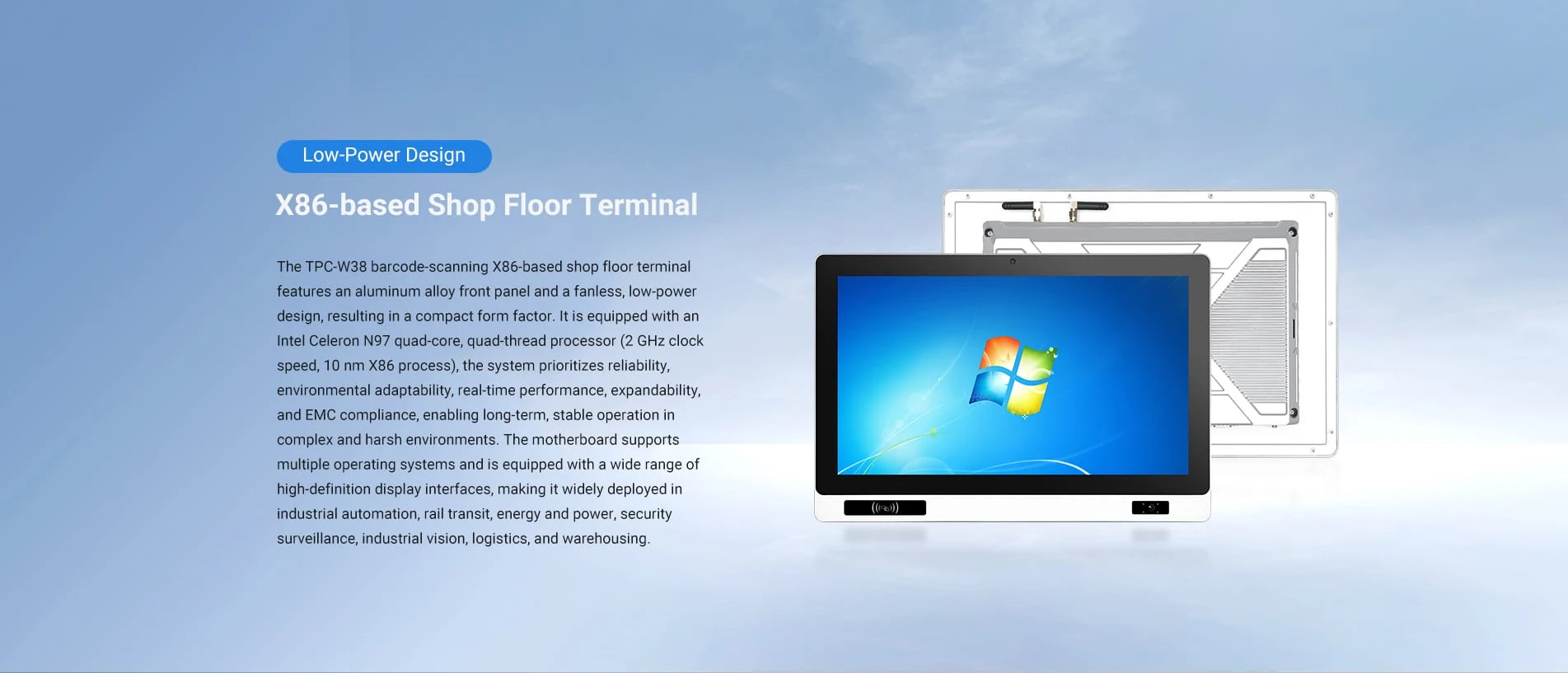
- Mechanical build: Aluminum alloy enclosure plus fan‑less passive cooling architecture. Resists dust and oil contamination, stable across wide operating temperature ranges, removing fan‑clogging failure risks.
- Integrated triple‑function module: On‑board 100W HD camera, 125KHz+13.56 MHz dual‑frequency RFID card reader, and high‑precision 1D/2D barcode recognition module. Operators finish material scanning, operator ID authentication and visual capture all on one unit without extra external accessories.
- Flexible mounting: Supports desktop placement, Montaggio a parete, swing‑arm / cantilever installation and embedded back‑mounting to fit diverse production‑line layouts.
- Display options: Multiple screen sizes available: 10.1”, 11.6”, 15.6” and 21.5”. Full‑viewing‑angle capacitive 10‑point multi‑touch panel is standard. Resistive touch and non‑touch versions are optional.
- Rich customizable interfaces: 12‑pin Phoenix terminals for configurable RS232, RS485, CAN bus signals. Serial ports can be jumper‑configured; opto‑isolation upgrade is available. Equipped with Gigabit RJ45 Ethernet, multiple USB ports, HDMI 2.0, audio I/O and SIM / TF card slots. Additional interfaces can be tailored per project requirements to connect most industrial peripherals without external adapters.
Multiple Hardware Variants for Different Use‑Cases
The terminal offers diverse CPU, combinazioni di memoria e sistema operativo che coprono stazioni entry-level con distribuzione di massa attraverso workstation di produzione core abilitate all'intelligenza artificiale.
Configurazione | Key Specifications | Target Application Scenarios |
ARM Architecture (RK3568 / RK3576 / RK3588) | Quad‑core Cortex‑A55 CPU; RAM:2GB‑8GB DDR; Magazzinaggio:32‑256GB eMMC; 6 TOP NPU indipendente; sistema operativo: Android12/13/14, Linux / Ubuntu / Debian | Mass‑deployed assembly stations, material‑tracking stations, operator ID check‑in, basic barcode data collection. NPU hardware acceleration supports lightweight on‑site AI vision tasks. |
X86 Architecture (Intel J6412/N97/I3/I5/I7) | Intel X86 processor; expandable DDR memory; NVMe storage option; LAN Gigabit; multi‑OS support | Automation lines requiring Windows compatibility, local historical work‑order data storage, custom MES secondary development. |
Energia & environmental capability: 12‑36 V wide‑range DC power input. Standard operating temperature:‑10 ℃ ~ 60 ℃; extended wide‑temperature version customizable down to ‑20 ℃ ~ 70 ℃. 95% non‑condensing humidity tolerance for harsh workshop environments.
Why Industrial‑grade MES Terminals Bring Better Long‑term ROI?
Many factories opt for consumer‑grade desktop or all‑in‑one PCs to cut upfront procurement expenses. This usually creates higher total‑cost‑of‑ownership in the long run. Commercial devices lack dust‑proof, industrial‑optimized mechanical structures; overheating and system crashes may occur within 1‑2 years. One unexpected production line stoppage can generate losses far exceeding the price gap between consumer and industrial hardware. Consumer PCs also lack native industrial serial interfaces, requiring unreliable external adapters for PLC and peripheral connections, with time‑consuming fault diagnosis during production incidents.
TouchThink delivers end‑to‑end industrial‑grade support: interface customization, OS image adaptation and pre‑deployment debugging, on‑site operator training and lifecycle maintenance services. Spare‑part inventory enables fast replacement for mass‑deployed projects. The hardware has been validated across multiple smart‑factory benchmark projects, proving reliable real‑world stability.
In 2026, manufacturing digital transformation imposes higher stability requirements for front‑end shop‑floor HMI terminals. As the direct HMI terminal for MES systems, terminal reliability directly shapes overall production efficiency. When selecting your shop floor terminal, pick ARM‑based RK series for mass‑volume basic stations with AI edge needs; select Intel N97 X86 configurations for Windows‑centric custom MES development. Matching hardware specifications to your actual workstation requirements will help you achieve stable, high‑efficiency production‑line operation.